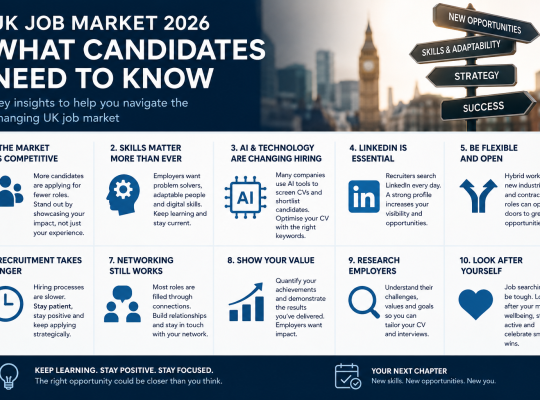
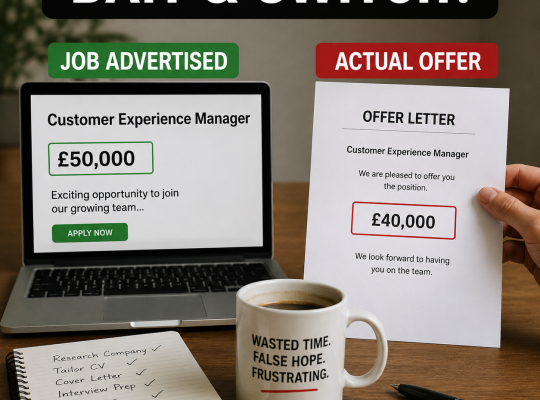
If you’re wondering why the UK job market already feels tighter, slower and less forgiving, you’re not imagining it.
And 2026 is not going to reverse that feeling.
It will sharpen it.
The Headline Everyone Misses
The UK economy is expected to grow in 2026.
But only modestly.
Forecasts from bodies such as the Office for Budget Responsibility and the Confederation of British Industry point to low-growth conditions, not recession and not recovery.
That distinction matters.
Because low growth doesn’t destroy jobs.
It changes how jobs are filled.
Why This Isn’t a “Bad” Job Market – Just a Selective One
In weak growth environments, employers behave differently:
- They hire fewer people, but expect more impact.
- They avoid risk, but will still invest where confidence is high.
- They replace roles quietly rather than expanding teams publicly.
This is why unemployment can rise at the same time as companies complain they “can’t find the right people”.
Both things are true.
The Vacancy Illusion
Headline vacancy numbers are falling.
Data tracked by organisations such as the Office for National Statistics shows job postings have declined from post-pandemic peaks, and unemployment is edging higher.
But that does not mean opportunity has vanished.
It means volume recruitment is disappearing.
What’s left is precision hiring.
Fewer roles.
Higher expectations.
Longer decision cycles.
Why Employers Are Hesitating
Three forces are shaping hiring behaviour going into 2026:
1. Cost Pressure
Wages, employer contributions and compliance costs remain elevated. Even modest hiring decisions feel expensive.
2. Uncertain Demand
Consumer spending is subdued. Businesses are cautious about building capacity they may not fully use.
3. Execution Risk
Hiring mistakes feel more dangerous in low-growth conditions. Employers want certainty, not potential.
This is why interviews are getting tougher, slower and more demanding.
The Big Shift Most Candidates Haven’t Clocked
In growth markets, employers hire for potential.
In flat markets, they hire for execution certainty.
That single shift explains most rejections.
Not:
“Are you capable?”
But:
“Can you deliver here, with us, under these conditions?”
Most CVs and interviews never answer that question.
Why “Good CVs” Are No Longer Enough
In 2026, almost everyone applying for mid-to-senior roles will look credible on paper.
Strong profiles.
Solid skills.
Impressive highlights.
What employers are struggling to see is how candidates actually operate.
How they:
- assess a starting position,
- sequence action,
- manage constraint,
- and adapt when reality deviates from plan.
That is the missing signal.
This Is Why Interviews Feel Different Now
Interviewers are less interested in stories about the past.
They are trying, often clumsily, to test something else:
“If we drop you into our mess, can you move us forward without breaking anything?”
Candidates who only talk about outcomes sound risky.
Candidates who explain process, judgement and trade-offs sound hireable.
What This Means for Job Seekers in 2026
If you are still competing on:
- titles,
- tenure,
- or generic achievements,
you are competing in the wrong arena.
The winners in 2026 will be those who can clearly articulate:
- the current state they walk into,
- the trajectory they help organisations move along,
- and the resources they know how to mobilise beyond themselves.
That is what de-risks a hire.
What This Means for Employers (Whether They Admit It or Not)
Employers are no longer buying skills.
They are buying clarity under constraint.
The best hires will not be the loudest, fastest or cheapest.
They will be the ones who demonstrate:
- realistic thinking,
- structured execution,
- and the ability to operate without perfect conditions.
The Truth About the 2026 Job Market
This is not a market for hope.
It is a market for precision.
Those who understand that will feel “in demand” while others feel stuck, despite having similar CVs.
Not because they are better.
But because they are clearer.
Final Thought
2026 will reward people who stop selling what they can do
and start explaining how they make things work.
The economy isn’t closing doors.
It’s narrowing them.
And the people who can walk through are the ones who understand why.