Over the last 12 months I noticed something interesting.
Despite posting regularly, engaging consistently and continuing to deliver results for clients, my LinkedIn visibility was steadily declining.
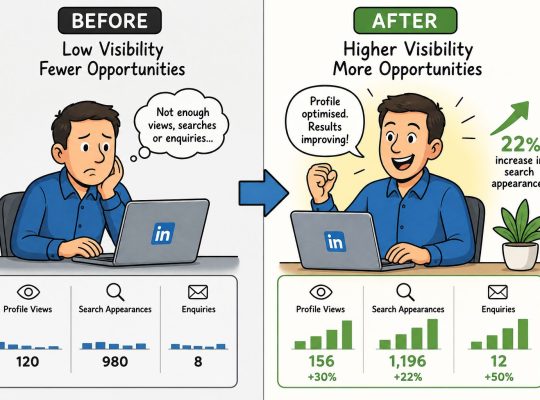
Search appearances fell from over 2,000 per week to under 150.
Profile views reduced.
Engagement became less consistent.
Inbound enquiries slowed dramatically.
This wasn’t a capability problem.
It was a visibility problem.
Like Google, LinkedIn is constantly evolving. What worked 12 months ago does not necessarily work today.
So this week I decided to completely revisit my own profile using the same methodology I use when optimising profiles for clients.
Here are some of the changes I made:
🟩 Refocused my headline around the services people actually search for
🟩 Rebuilt sections to improve keyword relevance and searchability
🟩 Improved profile structure to strengthen topic association
🟩 Enhanced service positioning to create clearer audience alignment
🟩 Increased consistency between headline, About section, experience and skills
🟩 Removed content that was diluting my professional positioning
🟩 Strengthened profile signals that help LinkedIn understand who I help and what I do
What many people don’t realise is that LinkedIn doesn’t just rank profiles based on experience.
It also evaluates profile completeness, relevance, keyword alignment, engagement signals, expertise indicators, network relationships, activity patterns and user behaviour.
Every significant profile update effectively gives LinkedIn new data to process.
In many cases, substantial optimisation can trigger re-indexing across multiple profile elements, helping improve discoverability in recruiter searches, member searches, suggested profiles and content distribution.
Will it instantly return me to 2,000+ search appearances?
Probably not.
But it gives LinkedIn a much clearer understanding of:
✔ Who I am
✔ What I do
✔ Who I help
✔ What topics I should be associated with
And that matters.
Because visibility drives opportunity.
Most professionals spend years building expertise but very little time ensuring the market can actually find them.
The reality is simple:
If LinkedIn cannot clearly understand your value, it struggles to show you to the right people.
I will be tracking the results over the coming weeks and sharing the impact, good or bad.
One thing is certain:
The professionals who consistently win attention are rarely the most qualified.
They are often the easiest for the market to understand.
Have you noticed a drop in LinkedIn visibility recently, or is it just me? 👇

Related Post
A Few Weeks Ago I Changed My LinkedIn Profile.
Why Most Professionals Stay Invisible on LinkedIn (Why That Matters More in 2026)

“Why do recruiters never call me back?”
What is Parsing of Data. Why Does It Matter in Recruitment?

How Best To Use LinkedIn, To Optimise Growth.